As in the song "Lawyers In Love" we have a land, a nation with too many in high places willing to do anything for money neglecting people, honor and principle but a change is coming. No more falling for the lie of living only individualistic and independent lives leaving us divided and conquerable by powerful special interests but a people, a nation collaborating for the greater common good in various groups all across the nation. A land of people working together to help one another with a vision moreover as Jesus would have us be. Love, Mercy, Forgiveness, Kindness....something about another Land. The change is coming

Wednesday, November 06, 2019

Trump Has Received a Formal Invitation to Be Impeached

The House resolution confirms the developments that will almost definitely end in the president’s impeachment.


On Thursday, five weeks after Speaker Nancy Pelosi announced a formal impeachment inquiry into President Trump, the House adopted a resolution confirming that inquiry. The timing is somewhat confusing: The House has had success in several recent court cases, and there’s nothing in the Constitution or in House rules that requires it to adopt a resolution to conduct an impeachment inquiry. So why now?

So far, the impeachment investigation has developed in mostly the same way as previous congressional investigations and impeachments. The recent depositions and testimonies taken by the Intelligence, Foreign Affairs, and Oversight Committees are similar to the discovery process done by the Senate’s Select Committee on Watergate. It, too, was an investigative arm; a formal impeachment inquiry wasn’t initiated in the House until a year later, in February 1974.

The depositions and evidence fundamental to Richard Nixon’s impeachment occurred through Congress’s normal oversight authority and capacity. It also eroded both his political support on Capitol Hill and his public approval, which plummeted 41 points between January of 1973 and January of 1974.

So for now, given the House’s support from the courts and ability to obtain critical information in the Ukraine scandal, you would think that passing a resolution is unnecessary, or at least bad timing.

DEBATABLE Agree to disagree, or disagree better? Broaden your perspective with sharp arguments on the most pressing issues of the week. Sign up here.

But the opposite is true: In cases like this, formalizing procedures establishes an unmistakable political and institutional intent. It is unlike political theater — press hits, speeches, storming a “sensitive compartmented information facility” at the Capitol — which politicians use to sway public opinion.

Procedures are where the rubber meets the road. Formalizing the impeachment investigation represents a significant shift from preliminary and largely behind-the-scenes work to much more public legal and political steps toward impeachment. It puts a spotlight on the elephant in the room: The political decisions have been made, and the House will impeach President Trump.

The resolution accomplishes several things. First, it undercuts the White House’s legal defense against impeachment. President Trump’s lawyers argued that House subpoenas lacked a “legitimate legislative purpose” because the House had not adopted a formal impeachment resolution. That defense runs counter to more than 90 years of legal interpretation establishing Congress’s authority to seek and obtain information based only on a “potential legislative purpose” with no predictable end. The president’s defense also carries major separation of powers implications, potentially limiting the scope of Congress’s oversight authority.

Nevertheless, the House resolution undercuts the president’s thin legal arguments and will expedite other House cases against the president, which — with the Ways and Means and Financial Services Committees included in the impeachment authorization — will clearly continue to be pursued.

Second, the resolution undermines the president’s political defense. Republicans argued the House’s inquiry is a “sham process.” Absent an impeachment resolution, they say, the investigation lacked transparency, due process rights for the president and the validity of a House vote.

They had a point. Until now, the impeachment inquiry had essentially been based on Speaker Pelosi’s statement at a Sept. 24 news conference. The distinction between the House and the speaker should not be overlooked. The speaker has lots of power, but it is not unilateral. It rests upon the support of the House majority. Without a majority, a speaker’s procedural authority amounts to very little, and that includes impeachment inquiries.

Passing a resolution throws the weight of the House of Representatives behind Speaker Pelosi’s words, clarifying the House’s purpose for judges who have, until now, been forced to interpret whether the House investigations amounted to an impeachment inquiry. It also undercuts Republicans’ process arguments by outlining investigation and hearing procedures and the rights afforded to the president throughout the proceedings.

But perhaps most important, the resolution details the specific roles of committees and members. The impeachment inquiry had raised a lot of questions. Why, for example, was Adam Schiff’s Intelligence Committee spearheading depositions and testimonies from State Department officials and not Eliot Engel’s Foreign Affairs Committee, whose jurisdiction covers diplomatic matters? Given the Intelligence Committee’s central role, would it report articles of impeachment rather than Judiciary, which has historically retained that power?

Politically, the answers appear obvious, but this overlooks the very real tensions behind the scenes. Several committees and chairmen can, and surely have, made legitimate arguments to be central participants in the impeachment inquiry. This resolution, like any offensive strategy, clearly delineates the role various powerful members and committees will play. A dysfunctional team running aimlessly around a field is doomed to lose. The House is no different.

Undercutting the president’s legal and political defenses is an important, but ultimately tangential, purpose of the House’s impeachment resolution. The resolution is most significant to the House Democrats’ game plan.

It anticipates a shift from scouting opponents to devising ways to beat them. It instructs House committee chairmen about their strategy and the scope of their inquiries. It provides a road map for how processes leading to articles of impeachment will unfold. And it ominously signals the first formal procedures that could, and almost definitely will, end in the president’s impeachment.

Joshua C. Huder


My take:
I will have to see the Republican held Senate actually impeach to believe it because they will have to overcome their beehive cult like stubbornness to achieve it. 

Saturday, October 19, 2019

The Coming S.F. Earthquake, Oakland Raider Comeback And The Prophetic Vision Of 1977 Revisited And Updated


In 1977 I sat down with a friend in his car and heard his prophetic vision about the future, mine and more. The "more" of course is what is relevant to most everyone else which includes predictions of a coming San Francisco earthquake, sports events and national crisis events including cyber war . This article now brings up to date and summarizes the essentials of the 2016 articles I wrote concerning the 1977 vision that came back to my memory in 2015. It should be understood this is about remembering a prophetic vision, not personally having one on my part. My friend that experienced the vision told me I was supposed to remember this vision for the future so with 2020 as the only date actually mentioned we should be approaching more unfolding events.

It has been over two years ago when I last addressed the events in the vision of 1977 but since then there have been some interesting developments.

Who would have thought that Jon Gruden the famous coach and then sportscaster-to-be-coach-again would return with the talent that awaited him on the Oakland Raiders and end up with a 4-12 won loss record and the fourth worst team in the NFL for 2018. At the beginning of the 2018 season there was little chance in anyone's mind that the Raiders would be anything less than a playoff contender especially after adding Gruden as the team's new coach.

The Raiders had gone from contender to big loser. Historically the team had been a big winner for decades then the 12 year drought from 2002 to 2014 hit but with the advent of Derek Carr the Raiders had apparently made their comeback in 2016 going from a 4-12 season two years before to a 12-4 season in 2016. It appeared big talent was coming into Oakland and would be years to come and no reason to think the Raiders would be in need of making any kind of comeback any time soon but then came 2018 and Jon Gruden. Shockingly a great coach comes to a good rising team and we get a virtual complete collapse.

Here is the news: Because this is Jon Gruden there has been much talk of a "comeback year" in 2019 so even though 2016 was a comeback year there was not nearly as much fanfare then about an upcoming "comeback year" as there is now.

With regard to the comeback year part of the vision it appeared a scenario in the vision with a comeback year for the Raiders had passed. It was hard to imagine with the talent they had and their rising status that this would be possible again in time to "align" with the rest of the vision come the rest of the events as I originally spoke about them but here we are. 2019 by most accounts is expected to be Gruden and the Oakland Raiders comeback year but of course those expectations could be delayed until 2020 or even the next few years.

To be honest I had just written it off and waited to see what would happen and I knew 2020 was supposed to be a pivotal year in the vision but honestly I'am just floored that this came back around. It can be said that this happens with teams periodically but in time for next year or 2020?

Several events in this vision occur in tandem with each other and it is not absolutely clear they happen necessarily in the same year but it would seem they certainly are in close proximity.

The comeback year of the Raiders definitely occurs with some kind of event that almost causes the cancellation of the football season but it is said in the vision that because the team is making a comeback they are glad the season is resumed. I cannot say that the event is definitely the cyber-war event, the death of a politician or delay of election event or earthquake or national crisis event.
I recall that the Raiders are struggling, barely making the playoffs but I cannot say with certainty yet any of those are part of the comeback year/season cancellation event.

There is the memory of the San Francisco earthquake and the Raiders having to prepare to play a game in a different stadium only to have the original earthquake damaged stadium repaired in time for the game. Levi Stadium keeps coming up in my memory of this but I cannot definitely say Levi stadium as of yet as one of the two stadiums in this particular event but Levi Stadium definitely was mentioned in the vision.
.
There is also the memory of the Raiders making it to the AFC title game and the quarterback injuring his hand and NOT playing in the Superbowl and there is of course the memory of the Raiders playing the Dallas Cowboys in a Superbowl in a year where the Chicago Cubs win the world series and an Oklahoma team wins a national championship. These two memories of events seem to be connected to the same year but it is not certain as of yet however it is certain the Raiders vs Cowboys, Cubs, Oklahoma national champion occur in the same year or season. Update here: With the Cubs loss in the NL Wild Card this month we can of course x that for now. This article was actually written in June but I held off probably a little too long.

Now with regard to the other events in the 1977 vision. I've considered whether the death of George H. Bush was the death of a prominent politician to occur in the fall of which Bush's did. I've leaned to the politicians death event being part of the reason why an election was delayed but it may stand alone. It occurred after the mid-terms so it was of no effect in 2018.

Certainly Russia's "cyber-war" event has been at the forefront of nearly every news day the last couple years but it hasn't delayed an election yet or attempted to cancel a football season or cause a national crisis that would impact the nation in a substantial way or has it? No doubt there is plenty brewing here and we shall see what unfolds.

The United States will have a national crisis and it will be said later that spring and summer that things are going to go back to business as usual but that will not actually be true, it will be a deception. All I can say here is get ready for that.

I also recall that a politician that I personally don't favor, and understand that Bruce made that clear in the vision as he spoke it to me in 1977, will be re-elected to a second term. He said however that I would get through that second term alright. Okay, now here I'am thinking that this memory was regarding George W. Bush. If it is Trump then it is Trump but there is the memory of someone with a short name coming up and actually getting elected here instead of a candidate i opposed but there was ambiguity for sure as if the end result was going back and forth. We will see.

There is also the recent remembering of a new Korean War that will end almost as soon as it begins as in a couple days. I remember earlier in the vision my friend mentioning both Iraq and Iran and that we would have a conflict with one of them but not the other. We talked briefly about the two nations and which one I should try to remember but that of course must have been regarding 9-11.
I also remember a scenario  where there are two nations we are dealing with, one we go to war with the other we do not but it turns out that we go to war with the nation we thought we would not go to war with. If this refers to now with Iran and North Korea then we know how this turns out as Trump has been cozy and friendly with Kim Jong Un while he rattles the sabre at Iran however one year ago it seemed the reverse as everyone thought we were on the verge of war with N. Korea with Iran on the back burner so I wonder if it will turn out that way but since I recall a 2nd Korean War that should be the scenario that plays out meaning war with N. Korea not Iran. As it is now war with Iran seems more likely however the vision is unconcerned with how it seems.

I also remember that there is a very hot summer or record setting summer immediately before the fall when some or perhaps the most prominent part of the vision occurs. With record global warmth occurring almost every year this is not very useful but it must refer to the U.S. or what we ourselves would experience at the time. I remember in earlier years, when small parts of this vision would come back to me, I would recall this aspect of the vision but for whatever reason I did not clearly recall it this time around or I just didn't want to preface the advent of the significant part of the vision with this requirement. Since it seems clearer to me at this time I feel I must include it now. It is what I remember about a summer before some significant events and I do realize I'm vulnerable to the notion of  recent years of increasing record highs influencing that clarity. I wonder myself.

That's at least three also's but here is a fourth. I have memories coming back clearer to me of an election where a candidate comes from behind but falters just before the election. I will leave it at falters because I don't want to say dies being in this more situation specific. But the leading candidate that came from behind is no longer in the race and the person that takes their place is not able to win the election in place of the original candidate. I clearly recall I was supposed to be for this candidate and the fallen candidate to win. There was supposed to be high drama here so it surely it is a presidential election and if so at this point it would mean Trump is re-elected unless he drops out or is impeached. As I said before there is ambiguity with this election scenario in my memory and there is the candidate with the short name that i favor that comes back and is elected.

With that is the final event that this prophetic vision was most probably prepared for, I haven't yet recalled whether this is it's definite purpose but 23 years after the upcoming San Francisco earthquake involved in the above events the entire downtown skyline of San Francisco will sink below the San Francisco bay all except for the tip of the Trans America Tower.

My friend Bruce did have a few other things for me in the vision on a personal note but he did mention two other things that always stood out. I asked if California would fall off into the ocean and he said no but that parts of it along the coast will sink below the surface and then I asked what about Los Angeles or San Diego and he said the Lord told him that is not to be my concern.

So as I understand it that is what I'm supposed to write here and all I recall for now.

Admittedly this is a strange way to handle a prophetic vision so it should be reiterated God moves in mysterious ways when necessary. The issue of remembering it is rampant but at least it's not a blurry image or something to be interpreted from layers of symbolic refrain or lost language.
Having said that it must also be said that we should not want something bad to occur since prophecies are for warnings so should prayer have averted the bad that is where it's at thankfully.

All Glory to the Lord God of all, Jesus Christ his Son and the Holy Spirit.

The original name of Jesus Christ in Hebrew - Hamashiach Yeshua. The name that was spoken as people were healed, demons fled, the dead rose and He ascended into Heaven.

The things of this world will fade away but the Love of the Lord will never fade away.


At a distance this man looks like he is praying but he is actually taking a picture. 
Both will be fully relevant.

Friday, October 11, 2019

How the Universe Stopped Making Sense

We're getting something wrong about the universe.


It might be something small: a measurement issue that makes certain stars looks closer or farther away than they are, something astrophysicists could fix with a few tweaks to how they measure distances across space. It might be something big: an error — or series of errors — in  cosmology, or our understanding of the universe's origin and evolution. If that's the case, our entire history of space and time may be messed up. But whatever the issue is, it's making key observations of the universe disagree with each other: Measured one way, the universe appears to be expanding at a certain rate; measured another way, the universe appears to be expanding at a different rate. And, as a new paper shows, those discrepancies have gotten larger in recent years, even as the measurements have gotten more precise.

"We think that if our understanding of cosmology is correct, then all of these different measurements should be giving us the same answer," said Katie Mack, a theoretical cosmologist at North Carolina State University (NCSU) and co-author of the new paper.

The two most famous measurements work very differently from one another. The first relies on the Cosmic Microwave Background (CMB): the microwave radiation leftover from the first moments after the Big Bang. Cosmologists have built theoretical models of the entire history of the universe on a CMB foundation — models they're very confident in, and that would require an all-new physics to break. And taken together, Mack said, they produce a reasonably precise number for the Hubble constant, or H0, which governs how fast the universe is currently expanding.

The second measurement uses supernovas and flashing stars in nearby galaxies, known as Cepheids. By gauging how far those galaxies are from our own, and how fast they're moving away from us, astronomers have gotten what they believe is a very precise measurement of the Hubble constant. And that method offers a different H0.

"If we're getting different answers that means that there's something that we don't know," Mack told Live Science. "So this is really about not just understanding the current expansion rate of the universe — which is something we're interested in — but understanding how the universe has evolved, how the expansion has evolved, and what space-time has been doing all this time."

Weikang Lin, also a cosmologist at NCSU and lead author of the paper, said that to develop a full picture of the problem, the team decided to round up all the different ways of "constraining" H0 in one place. The paper has not yet been formally peer reviewed or published, and is available on the preprint server arXiv.

Here's what "constraining" means: Measurements in physics rarely turn up exact answers. Instead, they put limits on the range of possible answers. And by looking at these constraints together, you can learn a lot about something you're studying. Looking through one telescope, for example, you might learn that a point of light in space is either red, yellow or orange. Another might tell you it's brighter than most other lights in space but less bright than the sun. Another might tell you it's moving across the sky as fast a planet. None of those constraints would tell you much on their own, but taken together they suggest you're looking at Mars.

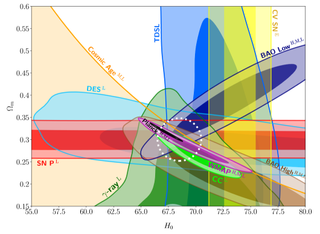
Lin, Mack and their third co-author, NCSU graduate student Liqiang Hou, looked at the constraints on two constants: H0, and something called the "mass fraction" of the universe, denoted as Ωm, which tells you how much of the universe is energy, and how much is matter. Many measurements of H0 also constrain Ωm, Lin said, so it's useful to look at them together.

That produced this colorful plot:


The central plot in the paper shows that most measurements of the Hubble constant and mass fraction point to one range of numbers, but the Cepheid-supernova measurement (yellow bar) points to a different range of numbers.
(Image credit: Weikang Lin, Katherine J. Mack, and Liqiang Hou)

The stretched magenta oval labeled WMAP is the range of possible mass fractions and Hubble constants that used to be possible based on a major past NASA study of the CMB, known as the Wilkinson Microwave Anisotropy Probe. The yellow column labeled CV SN (short for "Cepheid-Calibrated Type-Ia Supernovae") refers to the Cepheid-supernova measurements, which don't constrain the mass fraction of the universe, but do constrain H0. The red bar labeled SN P (short for "Type-Ia Supernovae Pantheon") is a major constraint on the mass fraction of the universe.

You can see that the edges of WMAP and CV SN overlap, mostly outside the red bar. That was the picture of the discrepancy a few years ago, Mack said: Significant enough to worry that the two measurements were turning up different answers, but not so significant as to render them incompatible with a little tweaking.

But in recent years there's been a new measurement of the CMB from a group called the Planck Collaboration. The Planck Collaboration, which released its latest dataset in 2018, put very strict constraints on the mass fraction and expansion rate of the universe, denoted by the black sliver on the plot labeled Planck.

Now, the authors wrote, two wildly different pictures of the universe emerge. Planck and WMAP — along with a range of other approaches to constraining H0 and Ωm — are all more or less compatible. There's a place on the plot, in the circle of white dashes, where they all allow for similar answers for how fast the universe is expanding and how much of it is made of matter. You can see that almost all the shapes on the plot pass through that circle.

But the most direct measurement, based on actually studying how far away things are in our local universe and how fast they're moving, doesn't agree. The Cepheid measurement is way out there on the right, and not even its error bars (the faint yellow bits, denoting the range of likely values) pass through the dashed circle. And that's a problem.

"There's been a lot of activity in this area just in the last several months," said Risa Wechsler, a cosmologist at Stanford University who wasn't involved in this paper. "So it's really nice to see everything summarized. Framing it in terms of H0 and Ωm, which are fundamental parameters [of the universe], is really clarifying."

Still, Wechsler told Live Science, it's important not to jump to any conclusions.

"People are excited about this because it could mean that there's new physics, and that would be really exciting," she said.

It's possible that the CMB model is just wrong in some way, and that's leading to some sort of systematic error in how physicists are understanding the universe.

"Everyone would love that. Physicists love to break their models," Wechsler said. "But this model works pretty well so far, so my prior is that there has to be pretty strong evidence to convince me."

The study does show that it would be difficult to match the Cepheid measurement from the local universe with all the others by introducing just one new piece of physics, Mack said.

It's possible, Mack said, that the supernovas-Cepheid calculation is just wrong. Maybe physicists are measuring distances in our local universe wrong, and that's leading to a miscalculation. It's hard to imagine what that miscalculation would be, though, she said. Lots of astrophysicists have measured local distances from scratch and have come up with similar results. One possibility the authors raised is just that we live in a weird chunk of the universe where there are fewer galaxies and less gravity, so our neighborhood is expanding faster than the universe as a whole.


The answer to the problem, she said, could be just around the corner. But more likely it's years or decades away.

"It's either something new in the universe or it's something we don't understand about our measurements," she said.

Wechsler said she would bet on the latter — that there's probably something not quite right about the error bars around some of the measurements involved, and that once those are resolved the picture will fit together more nicely.

Coming measurements might clarify the contradiction — either explaining it away or heightening it, suggesting a new field of physics is necessary. The Large Synoptic Survey Telescope, scheduled to come online in 2020, should find hundreds of millions of supernovas, which should vastly improve the datasets astrophysicists are using to measure distances between galaxies. Eventually, Mack said, gravitational wave studies will get good enough to constrain the expansion of the universe as well, which should add another level of precision to cosmology. Down the road, she said, physicists might even develop instruments sensitive enough to watch objects expand away from one another in real time.

But for the moment cosmologists are still waiting and wondering why their measurements of the universe don't make sense together.


My take:
Such concessions after so many years are a breath of fresh air. Maybe now we can think more broadly. Maybe now we are looking, really looking. 

Wednesday, October 02, 2019

'Nobody knows who we are': These Anonymous Oakland Athletics Roll Towards MLB Postseason


HOUSTON — They are new-school, they are old-school, they are heralded prospects, they are grizzled veterans, they are All-Stars, they are castoffs.

They are the 2019 Oakland A’s.

And they are scaring the living daylights out of the American League, with scouts from contending teams watching them and coming away with the same conclusion.

No one wants to play them in October.

The A’s (90-60) are absolutely rolling, a season-high 30 games over .500, with the best winning percentage in baseball since June 17, going 53-24.

This is a team that opened this past week getting pummeled, 15-0, by the Houston Astros, turned around and won the next game 21-7, and never lost again in the state of Texas, winning six in a row, outscoring the Astros and the Rangers, 57-28.

WILD-CARD RACES: Who's got the edge in the final two weeks?

POWER RANKINGS: Astros stay on top this week

It no longer seems like a question if the A’s will make the playoffs – their remaining 12 games are against the Kansas City Royals, Rangers, Mike Trout-less Angels and Seattle Mariners (combined .437 winning percentage) – but whether they’ll win that wild-card game and earn a right to play the Astros or the Yankees in the ALDS.

You think they’re scared? Or intimidated? The A’s just beat up both powerhouses the past month, winning 10 of 14 games.

“We got a junkyard dog mentality,’’ said All-Star closer Liam Hendriks, who has been designated for assignment five times in his career. “We’re a bunch of misfits in here. You see a bunch of guys who were DFA’d, claimed, came from different teams, to guys who have come up together here.

“We got a bunch of guys in here who have always been counted out. Nobody expects anything from us. We’ve been the underdogs all year. But that’s when we play our best baseball. We go out there and say, 'OK, nobody expects us to do anything, watch this.’

“Yeah, we have a little chip on our shoulder, and we don’t lack confidence.’’


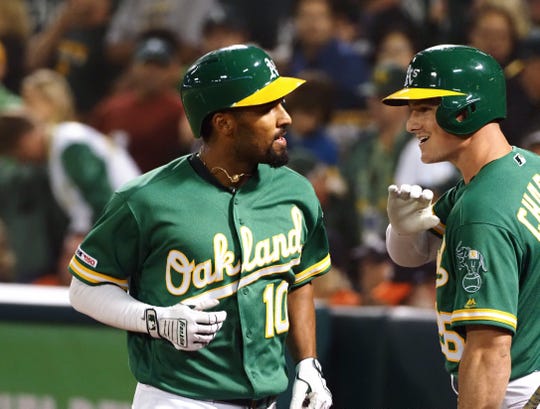
Shortstop Marcus Semien and third baseman Matt Chapman have been two of Oakland's biggest contributors. (Photo: Kelley L. Cox, USA TODAY Sports)

Go ahead and walk through the doors of the A’s clubhouse, and it’s feels as if you just entered your local VFW, with card games at each table, and an assortment of music that was on the Billboard charts before most were even born.

“It’s crazy around here,’’ said veteran starter Tanner Roark, acquired at the trade deadline. “The energy around here, I’ve never felt before. It’s always here. In the clubhouse. On the bench. On the field. Nobody even cares what the score is, whether we’re up, down, winning or losing, there’s never a thought that creeps into anybody’s head that we’re going to lose.

“I’ve never seen anything like it.’’


'That's just who we are'

The A’s, with only the 25th-highest payroll in baseball ($95.3 million), not only are one of the most likable teams in the game, but also happen to be supremely talented. They have hit a franchise-record 244 homers, with seven players already having 20 or more, including three with at least 30 homers. They have perhaps the best corner infield tandem in baseball with third baseman Matt Chapman and first baseman Matt Olson. They have one of the finest all-around shortstops in the game in Marcus Semien, who tied Hall of Famer Rickey Henderson’s franchise record Sunday with his 28th homer from the leadoff spot to go along with his 115 runs and 85 RBI.

Get the Sports newsletter in your inbox.
Sports news, no matter the season. Stop by for the scores, stay for the stories.

Delivery: Daily
Your Email
They have slugger Khris Davis, who has the third-most homers in baseball since 2016. They have center fielder Ramon Laureano, who has the most lethal arm in the game. They have a great mixture of veteran pitchers, youngsters and stud prospects all contributing valuable innings right now. And they can play defense, allowing just 33 unearned runs this season, fewest in the major leagues.

Yet, go ahead, you try to identify them in a crowded hotel lobby.

“Nobody knows who we are,’’ said Chapman, whose 34 homers are the most by an A’s third baseman in franchise history. "Nobody cares. And that won’t change.

“I could say I worked for FedEx, and people would believe me.

“That’s just who we are, but we know we can win baseball games.’’

It’s this Oakland vs. the World mentality that has built a close-knit core, with manager Bob Melvin calling it perhaps the best clubhouse he has been around in his 38 years of professional baseball.

“We have guys in here who really take pride in being the Oakland A’s,’’ Melvin said. “We have had a hard time sometimes with that with free agency, but these guys are different. They aren’t looking for their next deal. They want to be here. There’s value in that.’’

Then again, says Semien, who was born and raised in the Bay Area and played at Cal, maybe they have no choice.

“Our clubhouse is so small, there’s really no place for us to go,’’ Semien says, “so we have to be close. We just have a bunch of low-key guys that understand each other and what we’re all about.’’

They may not yet be rich. Or famous. But they’ve got one another until that time comes again when the organization can no longer afford to keep them all together.

“In an era where numbers are so scrutinized and emphasized,’’ outfielder Stephen Piscotty said, “I think team chemistry is left behind. It’s hard to quantify, but we got that going here. We put ourselves on the map last year, we showed this year that it wasn’t a fluke, and we have a young core that’s going to make us even better in the future.’’

Built for the future
There's finally optimism that by the time rookie pitchers Jesus Luzardo, A.J. Puk and catcher Sean Murphy are in their prime, they may actually be playing their home games in an actual modern ballpark instead of their current dump. The Athletics are progressing toward a waterfront stadium that could be ready by 2023.

“People talk about windows in baseball, well, we’ve got a huge window here,’’ Semien says. “We’ve got controllable guys. We’ve got youth. We’ve got veterans to blend in the youth. And we have talent through-the-roof pitching coming up.

“That’s where the A’s had their first run years ago when this first started with young controllable pitchers, right?’’

Those days may be forever remembered as the advent of “Moneyball,’’ but what the book conveniently excluded was that those A’s teams also happened to have Barry Zito, Tim Hudson and Mark Mulder anchoring the rotation, too.

The A’s can’t help but dream about the future with a trio of Luzardo, Puk and Sean Manaea pitching to Murphy.

“We’re excited too,’’ says Luzardo, 21, who has lived up to the hype since his call-up, yielding just three hits and striking out six batters in six innings with a dazzling array of pitches and poise. “We talked about being part of this every single day in the minors. It’s everything I expected it to be.’’

It’s exactly what Davis envisioned all along, too, when he signed a two-year, $33.5 million contract extension this spring, knowing he could earn more elsewhere, but believing they are on the brink of greatness.

“That was the main factor in committing to Oakland,’’ Davis said, “just wanting to be part of this, being around good ballplayers who have a chance to do something special. There’s just a different feeling here. It’s the culture. Bo-Mel and his staff do a wonderful job just letting us play, expecting us to play the game the right way, too.

“And all we expect to win. Every single day.’’

The A’s will almost certainly be back on the national stage on Oct. 2, the date of the American League wild card game.

They realize no one will give them a shot to go far, even if they get past the Rays or Indians. History is against them. They haven’t won a wild-card game or even a playoff series since 2006. Their last World Series appearance was 1990.

Then again, this team somehow feels different. Not with an arrogance, but a confidence that they’re going to be sticking around for a while in October.

“I’m sure nobody outside of Oakland is really paying attention to us,’’ said Olson, whose team went 15-19 when he was on the injured list, only to play at a .655 clip (74-39) since his May 7 return. “We’re a small-market team that plays on the West Coast. So we’ll always be the underdog. That’s out of our control.

“But if we go out, keep playing like we have, we know we can change that in a hurry.’’

- Bob Nightengale

My take:  Tak'in a breath

Monday, August 26, 2019

Alarm In Texas As 23 Towns Hit By 'Coordinated' Ransomeware Attack


  • Key Points:
  • Twenty-three Texas towns have been struck by a “coordinated” ransomware attack, according to the state’s Department of Information Resources.
  • According to a weekend update by the deparment, the attacks started Friday morning and though the locations aren’t named, “The majority of these entities were smaller local governments.”
  • The attacks come after state and local ransomware attacks in New York, Louisiana, Maryland and Florida resulted in the loss of significant sums.

Twenty-three Texas towns have been struck by a “coordinated” ransomware attack, according to the state’s Department of Information Resources.
Ransomware is a type of malicious software, often delivered via email, that locks up an organization’s systems until a ransom is paid or files are recovered by other means. In many cases, ransomware significantly damages computer hardware and linked machinery and leads to days or weeks with systems offline, which is why it can be so costly to cities.
According to a weekend update by the Texas DIR, the attacks started Friday morning and though the locations aren’t named, “the majority of these entities were smaller local governments.”

Texas Governor Greg Abbott ordered a “Level 2 Escalated Response” on Friday following the incident, according to a statement from Governor’s Office deputy press secretary Nan Tolson. This response level, determined by the state’s Department of Emergency Management, is part of a four-step response protocol, and is one step below the highest level of alert, level 1 or “emergency.”

According to state emergency management planning guide, this means “the scope of the emergency has expanded beyond that which can be handled by local responders. Normal state and local government operations may be impaired.”

In addition to the state and local agencies assisting with the response, “Governor Abbott is also deploying cybersecurity experts to affected areas in order to assess damage and help bring local government entities back online,” Tolson said. 

The attacks follow recent state and local ransomware attacks in New YorkLouisianaMaryland and Florida resulted in the loss of significant sums — either in ransom demands to criminals or in repairs for the damaged caused by them. It’s also still unclear whether any of the Texas jurisdictions paid ransom to the attackers, or whether the same criminals are linked to the attacks on other U.S. cities.

“The State of Texas systems and networks have not been impacted. It appears all entities that were actually or potentially impacted have been identified and notified,” the DIR said. While the state has determined that one “threat actor” was responsible for all 23 attacks, they have not yet determined who was responsible. “Investigations into the origin of this attack are ongoing; however, response and recovery are the priority at this time,” the department said.

Texas is being assisted by numerous federal and state agencies, including FEMA, the Department of Homeland Security, Texas A&M’s Information Technology and Electronic Crime Unit and the Texas Military Department, which includes branches of the National Guard.

Edward Block, who served as the Texas state Chief Information Security Officer until October 2016, said he expects the state and local governments are keeping the names of the locales private while they work to fix the problems in those areas.

“I would suspect that there are systems that are still being recovered,” said Block, who now serves as an Austin-based attorney in the technology transactions practice at law firm Foley Gardere. ”[Going public] kind of paints a target on the back of those agencies,” he said, including from other criminals who may look to capitalize on the attacks and launch more. 

- Kate Fazzini, CNBC


My take: We need to pay attention here.

Saturday, August 17, 2019

Trump, Barr, Epstein And The Oligarchy Or Real Change Rarely Moves


When someone really tries to change things or expose and overthrow corruption it usually barely happens. John F. Kennedy tried it and he was shot. The changes he started and the changes he made he paid for.

When the entrenched interests need to be changed it hardly ever happens. Along came Ross Perot who was going to get corrupt campaign money out of politics and bring to bear a transformational change to the system akin to a Kennedy change wave, was leading the pack through the middle of the summer 1992 and then mysteriously began backing out from pressure from the oligarchy serving GOP.  Real change never happened although reform movements tried and U.S. Senator John McCain backed real campaign finance reform which fizzled. Keep in mind here, some very important people thought this issue was of the highest importance but only a few with the courage stood up.

Barack Obama made changes but beyond healthcare they were mainly peripheral. The core change that should have happened, reforming money in politics, of which early on he said he would strongly pursue was laid on the back burner as he strangely began taking big corporate money in the midst of his campaign sending the signal to Wall Street he wouldn't dog them. He didn't and for that he was "allowed" to carry on with his "smaller" agenda. I should add Bill Clinton had this "understanding" with Wall Street and he always was reticent to talk the get money out of politics talk. If you were paying attention you know this is true and at the time it was no secret and I should say this was also at the core of doubt about Hillary Clinton. People still however thought Bill Clinton would go after that corruption but he didn't just like people, particularly independents, thought Trump would but did and continues to do just the opposite.

Recently the NSA began spying on all Americans and nothing has really been done about it meaning it essentially continues. The rich and powerful so uneasy over uncertainty and even minor instability want their imposing security state and it remains. It remains.

The nation desperately needed a more balanced Supreme Court to curb the expanding surveillance state and the undo influence of the rich and powerful on our democracy but at the very crossroads we get a candidate that should not and was not expected to win in 2016, the candidate that would put justices on the court that would instead reinforce everything that needed changing and he won and reinforced the status quo.

You have a two year investigation into Russian cyber meddling into our elections and possible criminal wrongdoing by the executive branch and you get an Attorney General, William Barr, put in place by the presidential candidate that favored Wall street and the rich and powerful that should not have been elected, doing everything possible to cover for and protect not only Trump but the rich and powerful with unnecessary redactions in the Muellar report and then constricting his testimony to congress so that little is said and little exposed about the rich and powerful and the truth.

Now we have Jeffery Epstein dead in a jail cell supposedly by suicide, an individual that was ready to testify in court and blow open ties to child sex slaves involving many high profile names of the, yes you guessed it, rich and powerful. A list of names remains but one only knows who else Epstein would have implicated.

And that's just the political aspect. Just when Christianity seemed like it was on the cusp of making a real difference across the board in the late 70's it began to take a much more conservative defensive turn siding seemingly at almost every turn with those who, yes you guessed it, represented the interests of the rich and powerful. A dynamic transforming movement was transformed into a protector of already entrenched interests. The Jesus movement did contribute to Christianity in its new conservative focus but in it's attachment to a growing materialism and right wing politics missed the influence it could have had on a broader public and massive mission field. Once again an opportunity for real transformational change is thwarted by the oligarchy of which the founders of this nation warned about.

You know full well there is so much left out above that could be included but I just wanted to get something down about all this. It has been frustrating all my life from Kennedy to now when just before a blockbuster testimony in court an individual with Jeffrey Epstein's ties to the rich and powerful maddenly and mysteriously appears to have been allowed to commit suicide when so much was on the line.
And with that thought more comes to mind as in the strange aligning of the media to support the Iraq war when it was so clear little of it made sense and then in 2008 bankers across the board getting off from their responsibility in the financial meltdown and how such a strange subservient document like the bogus "Citizen United" scam could get pass the Supreme Court except that this court is one stacked with right wing idealogues by representatives of the oligarchy.

A book or make that books could be written but this is just a little venting for now. One thing is for sure, the continual failure of government to bring the rich and powerful to account or expose corruption erodes the public's confidence in our institutions and government and it is exactly what our adversaries around the globe desire. With the likelihood that future control of nations will be transferred via result of "covert" cyber-war the stakes are even higher. The more distance between our We the People government and it's people the more precarious our situation.

One more thing, a thought of possible encouragement. Changes often are blocked up front but once a leader begins a change wave initially successful or not, the people, the American people, in various groups across the nation often begin working toward these worthwhile changes. They have and they are.
What the oligarchy, plutocracy, deep state or whatever you call it gets out of this resistance to change, besides getting their own way in so many of these matters, is they also in the  process discourage you from participating in the democracy that has authority over them but your job is to do just the opposite.

Don't be discouraged, be stubborn and persistent in your duty prescribed to you by the founders.
Be encouraged and join in.   

Friday, August 16, 2019

August Selloffs Are Always Exacerbated By Summer Vacation Low Market Volume


I mentioned this to several people the last couple weeks and here it comes again. The Bond Yield Curve inverting is always going to be noticed by investors especially when some aspect of it stands out and Trumps trade war with China doesn't help but the main point here is that any negative news is always amplified in the stock market during summer vacation time because trading volume is low meaning there are few investors around to buy back stocks when others sell them off reacting to negative news. During most of the year you have opportunistic investors with their own contrarian angle on the market ready to swoop up stocks when they see negative reactions but in the summer especially August and September they are not there to buy them back so the stock continues to drop often precipitously. What is so amusing is that the news outlets, even market news outlets seem to want to remain oblivious to this in their "horrific" reporting of the market drop. Panic in the market opens up opportunities for large investor buy backs of course so what you get is just some more oligarchic playing of the less informed people. The factors mentioned above are serious of course but just keep this all in perspective relative to the time of year. You do understand there is a stock market crash coming at some point and it could be now? The things we have to put up with. 

Monday, August 12, 2019

The Climate Crisis Is A Public Health Crisis


The climate crisis may be the most critical public health problem of this century. 70 U.S. healthcare organizations including the American Medical Association, the American Academies of Family Practice and Pediatrics, and the American Heart and Lung Associations endorsed a report about public health and climate change titled “U.S. Call to Action on Climate, Health, and Equity: A Policy Action Agenda.” Human actions have increased the global mean surface temperature by 1°C (1.8°F) thus far and will continue to raise temperature by 0.1 – 0.3°C (0.2 – 0.5°F) per decade if greenhouse gas emissions continue. These changes in temperature will massively impact public health in a number of ways.
As ocean temperatures rise, tropical storms become larger, more powerful, and cause more rainfall. Many of these events are happening now. This year has seen record heat waves across the U.S., Europe, and Greenland; floods in the U.S. Midwest; and wildfires in Alaska, Siberia, Greenland, and the Western United States. In 2017 and 2018, there were unusually powerful and large hurricanes such as Harvey (Texas), Florence (North Carolina), Maria (Puerto Rico), and Irma (Florida and Caribbean). Lyme disease and West Nile virus encephalitis have been spreading north from the U.S. into Canada as warmer temperatures make survival easier for ticks and mosquitoes. As the tropics expand towards the poles, diseases carried by mosquitoes follow. The Middle East (Southwest Asia) may become too hot for human habitation. Coastal cities such as Jakarta, Indonesia; Mumbai, India; Shanghai, China; London, U.K.; Miami, New Orleans, and New York may become uninhabitable due to sea level rise.
Heat, droughts, and floods are reducing agricultural harvests. Longer warm seasons and warmer temperatures are expected to augment the numbers of insect agricultural pests. Hunger and undernutrition may increase worldwide. Fresh water may be compromised by contamination with floodwater, by blooms of toxic algae, or by salt intrusion from rising seas. Floods often introduce bacteria and toxins into sources of drinking water. For example, floodwaters from hurricane Florence contaminated fresh water with animal manure from farms and with toxic coal ash from power plants. Droughts may reduce available fresh water from lakes, rivers, and aquifers.
Heat-related illness such as hyperthermia (heat stroke) and heat-related kidney disease will increase particularly among outdoor workers and the elderly. Diseases exacerbated by air pollution such as asthma, heart disease, and chronic pulmonary disease may also be made worse by high heat and humidity. Mental illness such as anxiety, post-traumatic stress, and depression may become even more prevalent. Diseases carried by mosquitoes and ticks such as Lyme disease, dengue fever, zika virus infection, and malaria are already becoming more widespread geographically. Climate-related disasters such as floods, fires, or hurricanes may overwhelm health care, agricultural, and drinking water infrastructure. Water contamination due to microorganisms in flood waters (Campylobacter, Salmonella, Vibrio cholerae, Cryptosporidium) or toxic algae may cause outbreaks of diarrheal illnesses.
In addition to warmer ocean water, there is ocean acidification caused by CO2 emissions. Carbon dioxide from the atmosphere dissolves into and combines with water to form carbonic acid. Carbonic acid makes the ocean more acidic (lowers ocean water pH). As our actions add more CO2 to the atmosphere, ocean pH declines. Some organisms will have difficulty surviving. For example, corals, mollusks, and oysters have less ability to make shells as pH falls. If these organisms cannot survive, organisms that depend on them also may die. In general, the more acidic the ocean becomes, the fewer sea organisms can survive. Ocean water warming and acidification not only harm sea life, but also are likely to harm humans by reducing ocean harvests.
The World Health Organization estimates that, without efforts to mitigate climate change, 250,000 persons will die from climate change each year from 2030 to 2050. At the present time six to nine million premature deaths are caused by pollution each year. These deaths are predominantly due to exacerbations of heart and pulmonary disease in countries with severe air pollution.
Recognizing and acting on climate change improves the health of every person in the world and diminishes threats to future generations. Each person can be an effective steward by reducing their individual use of fossil fuels and petroleum products and by participating in collective efforts to replace fossil fuels and plastics with renewable resources. Our response will determine the state of human health for centuries to come. If people from wealthy nations act to reduce climate change and require their governments to act, the climate crisis can be averted.
- Bruce R. Krawisz

My take:
What if the sun is actually diminishing and the present global warming becomes a saving grace to what we could face? Some might say we still should not put our environment in such dangerous conditions and I agree. We are not absolutely sure what our sun will do next but here is one thing to consider and Christians should surely consider, particularly Christians focused on the end times. These end times coming are not about the cold or a temperate climate, they are about the heat of the sun scorching men and great sores coming upon them, about one-third of the trees and grass burning up, about the sea turning to red and other symptoms that can be tied much more likely to a heated earth.
Evangelicals, conservative Christians and all have before them and within them biblical evidence for global warming, that is if they really believe these are the end times and, or they can divorce themselves from the singular interests of the powerful petroleum energy using complex.

Friday, August 09, 2019

GOD, GUNS, AND THE SEDUCTIVE POWER OF 'SPIRITUAL WARFARE'


WHEN PEOPLE ASK HOW CHRISTIANS CAN SUPPORT TRUMP GIVEN THE MASS MURDERS, THEY FORGET THE INVISIBLE MATH BEING DONE.

As a writer and academic living in New York City, I often forget how close I was to becoming a radicalized conservative while growing up. I was raised on the notion of God and country first. Everything else played second fiddle, whether friendships, education, art, or occupation. My parents, who met in Bible college, believed that Christians were slowly losing ground to Satan in various ways — from governmental socialism to abortion to liberal-biased reporters. I have written elsewhere how my mother, fueled by this kind of Christian fundamentalism, ended up having a psychotic break while we lived in Texas. I fared only slightly better with my father, who worked for Jim and Tammy Faye Bakker at Heritage USA and then moved us to Colorado to work Paul Crouch of the Trinity Broadcasting Network. My father’s job was fulfilling the great commission by making sure all countries, cities, and villages, no matter how remote, heard about Jesus Christ via television. If the enemy was going to infiltrate the media, TBN would be a safe haven for the faithful.
Once I got to college, I joined a conservative Christian group. We hung out and formed Bible studies. We didn’t smoke or drink or have sex, and yet this group was full of young, charismatic students. Every spring break we went on a mission trip to Mexico. We didn’t talk about the rapture very often, but we knew the end times could be just around the corner, and it was our job to save as many people as we could from eternal damnation.
With that directive came the promise of persecution. Jesus warns his disciples that they are still blessed when “people hate you, when they exclude you and insult you and reject your name as evil, because of the Son of Man” (Luke 6:22). In fact, the more you were persecuted, the more you knew you were in God’s will. This paradigm is a dangerous one. It seduces many American Christians into thinking they are the marginalized and oppressed.
It shouldn’t have surprised me then, when I looked up a friend from that college group on Facebook to see a profile picture of him and his wife happily holding rifles instead of each other. His family pictures were much of the same, each beaming son and daughter holding a rifle. A shared post dated from 2016 displays a gun seller’s contest video for an AR15 that “shoots fire and pisses freedom.”
I searched for other friends from that group. A few more had similar pictures. The reasoning for such firepower switches quickly and seamlessly between hunting and protection. My father, retreating further into radical, end times theology had given me a loaded pistol as a college graduation gift. I stayed with a friend of his after college, an older woman in her 60’s who stocked her home with so many canned goods, the place felt claustrophobic. She explained she wanted to be prepared for when the antichrist controlled the food supply. For she and my father, the war on God and country was never theoretical. The antichrist would work through legislation and technology just as much as by demonic force.
The churches I attended reinforced this thinking. Sermons focused on how we needed to take back the city of Denver for God. I was known as a “prayer warrior” against Satanic forces. But a subtle transformation had begun during my four years in college. My professors pushed me to critically examine the rhetoric of my own faith. By my junior year I had given up going to Mexico as a missionary to compete as a delegate in the Model League of Arab States in Washington, D.C. By the time I had graduated, I might have been an accidental gun owner, but I no longer thought of GOP as God’s chosen political party.
I was a couple of years into graduate school when my father wrote that he had a secret compound in another state so that we could run when it became too dangerous to be a Christian. He wanted me to know the location. I declined the offer, thinking my chances might be slightly better with the antichrist. My step sister later told me it was stocked with guns and food. I stopped all communication with my father. Between graduate classes and my therapist’s office, I started to work on dismantling the apocalyptic thinking that had kept me in constant state of anxiety. My father didn’t fare so well. He died this year, in a trailer in Texas, still waiting for the Second Coming.
There are many others who have not made it out. They are trapped in this spiritual matrix where they see themselves as soldiers and prophets trying to restore order. The video my friend shared on his wall was also shared by 69,700 other users and had 1.5 million views back in 2016. It was known as the “Never Hillary” giveaway contest.
We need to discuss the various rhetorics that work in conjunction to keep gun violence in motion — white supremacy, Christianity, and a toxic masculinity that is the inheritance of a mythologized America. Fighting a spiritual war allows a certain amount of collateral damage for many white evangelicals. When people ask how Christians can support Trump given the mass murders, they forget the invisible math being done. There might be hundreds of deaths due to guns, but there will be millions of unborn babies saved. To take away the right to bear arms is second only to getting the mark of the Beast. Healthcare for everyone veers too closely to socialism, which to a conservative Christian represents atheism. Lost lives are nothing compared to lost souls. Franklin Graham often reminds his followers on Twitter and Facebook that Christians are persecuted and therefore need extra prayer and legal protection.
It is this siege philosophy that will keep conservative Christians tied to Trump, no matter how many more shootings happen. We need to recognize that Trump uses religious rhetoric very persuasively when he needs to. He will continue to make mental illness and “cowardice” the culprit. He will protect them from a government system that might one day track them. He will throw around phrases about God and country and fake news while Christians cluck their tongues and say the shooter needed salvation. They will pray more fervently. They will polish their guns because war is still coming.
- Nancy Hightower
My take:  I agree almost completely with Nancy's assessment of the error of conservative Christians in their fear manipulated climate but I don't throw anything of the Lord's aside because of my travail and difficulty with them. The error of other Christians will not deter me from the truth and that is not always easy. I don't deny the absolute need to pray relative to spiritual warfare, the working of dark forces, the end times or some need to be prepared materially but my difference is in the mentality of an overcoming spirit with the confidence of God that keeps me free from so much of that fear the conservative right are in bondage to. I insist being on the offense and not the defense. Showing God's love not running from an anti-christ. Sharing God's love, not drumming about in a spirit of militarized judgement and inordinate fear so manipulated by political operatives in service to power and money. Step back and assess all these things and it's not that hard to see the manipulations occurring out there. All it needs to be is clearly called out and it's coming. A powerfully spiritual people will be freed to fly high again and with that witness raise a falling world. 

Sunday, August 04, 2019

After El Paso, We Can No Longer Ignore Trump’s Role in Inspiring Mass Shootings

From left, Melody Stout, Hannah Payan, Aaliyah Alba, Sherie Gramlich
 and Laura Barrios comfort each other during a vigil on Aug. 3, 2019, 
for victims of the shooting in El Paso, Texas. 
Photo: John Locher/AP


ON SATURDAY MORNING, a gunman at a Walmart in El Paso, Texas, shot and killed at least 20 people before surrendering to the police. By all accountsPatrick Crusius, the 21-year-old alleged shooter, is a fan of President Donald Trump and his policies. According to the Southern Poverty Law Center, “a Twitter account bearing the suspect’s name contains liked tweets that include a ‘BuildTheWall’ hashtag” and “a photo using guns to spell out ‘Trump.’”
Incredibly, the nation woke up to more grim news on Sunday, with reports that a man suited up in body armor and bearing a rifle with high-capacity magazines had carried out a rampage in Dayton, Ohio, killing at least nine people and injuring 26.
Little is known yet about the Dayton shooter, but a four-page manifesto authorities believe was written by Crusius and posted shortly before the El Paso attack is full of the kind of hateful rhetoric and ideas that have flourished under Trump.
The manifesto declares the imminent attack “a response to the Hispanic invasion,” accuses Democrats of “pandering to the Hispanic voting bloc,” rails against “traitors,” and condemns “race mixing” and “interracial unions.” “Yet another reason to send them back,” it says.
Sound familiar? The president of the United States — who condemnedthe El Paso attack on Twitter — has repeatedly referred to an “invasion”at the southern border; condemned Mexican immigrants as “rapists” and Syrian refugees as “snakes;” accused his critics of treason on at least two dozen occasions; and told four elected women of color to “go back” to the “crime infested places from which they came.” (It is worth noting that Crusius, in his alleged manifesto, claims his views “predate” and are unrelated to Trump, but then goes on to attack “fake news.”)
That there could be a link between the attacker and the president should come as no surprise. But it might. Over the past four years, both mainstream media organizations and leading Democrats have failed to draw a clear line between Trump’s racist rhetoric and the steadily multiplying acts of domestic terror across the United States. Some of us tried to sound the alarm — but to no avail.
“Cesar Sayoc was not the first Trump supporter who allegedly tried to kill and maim those on the receiving end of Trump’s demonizing rhetoric,” I wrote last October, in the concluding lines of my column on the arrest of the so-called #MAGAbomber. “And, sadly, he won’t be the last.”
HOW I WISH I could have been proven wrong. Yet since the publication of that piece almost a year ago, which listed the names of more than a dozen Trump supporters accused of horrific violence, from the neo-Nazi murderer of Heather Heyer in Charlottesville to the Quebec City mosque shooter, there have been more and more MAGA-inspired attacks. In January, four men were arrested for a plot to attack a small Muslim community in upstate New York — one of them, according to the Daily Beast, “was an avid Trump supporter online, frequently calling for ‘Crooked Hillary’ Clinton to be arrested and urging his followers to watch out for Democratic voter fraud schemes when they cast their ballots for Trump in 2016.”
In March, a far right gunman murdered 51 Muslims in two mosques in Christchurch, New Zealand — and left behind a document describing Muslim immigrants as “invaders” and Trump as “a symbol of renewed white identity and common purpose.”

And now, this latest massacre in El Paso. Let’s be clear: in an age of rising domestic terrorism cases — the majority of which are motivated by “white supremacist violence,” according to FBI Director Christopher Wray — Trump is nothing less than a threat to our collective security. More and more commentators now refer, for example, to the phenomenon of “stochastic terrorism” — originally defined by an anonymous blogger back in 2011 as “the use of mass communications to incite random actors to carry out violent or terrorist acts that are statistically predictable but individually unpredictable.”
Sounds pretty Trumpian, right? As I wrote in October: “The president may not be pulling the trigger or planting the bomb, but he is enabling much of the hatred behind those acts. He is giving aid and comfort to angry white men by offering them clear targets — and then failing to fully denounce their violence.”
And as I pointed out on CNN earlier this year, there is a simple way for Trump to distance himself from all this. Give a speech denouncing white nationalism and the violence it has produced. Declare it a threat to national security. Loudly disown those who act in his name. Tone down the incendiary rhetoric on race, immigration, and Islam.
Trump, however, has done the exact opposite. In March, in the wake of the Christchurch massacre, the president said he did not consider white nationalism to be a rising threat, dismissing it as a “small group of people.” A month earlier, in February, Trump was asked whether he would moderate his language after a white nationalist Coast Guard officer was arrested over a plot to assassinate leading journalists and Democrats. “I think my language is very nice,” he replied.
In recent weeks, the president has again launched nakedly racist and demagogic attacks on a number of black and brown members of Congress, not to mention the black-majority city of Baltimore. When his cultish supporters responded to his attack on Rep. Ilhan Omar, D-Minn., with chants of “send her back,” Trump stood and watched and later referred to them as “patriots.”
So we’re supposed to be surprised or shocked that white nationalist violence is rising on his watch? That hate crimes against almost every minority group have increased since his election to the White House in 2016?
On Tuesday, just days before this latest act of terror in El Paso, the leaders of the Washington National Cathedral issued a scathing, and startlingly prescient, rebuke of Trump:
Make no mistake about it, words matter. And, Mr. Trump’s words are dangerous.
These words are more than a “dog-whistle.” When such violent dehumanizing words come from the President of the United States, they are a clarion call, and give cover, to white supremacists who consider people of color a sub-human “infestation” in America. They serve as a call to action from those people to keep America great by ridding it of such infestation. Violent words lead to violent actions.
Thanks to his hate-filled rhetoric, his relentless incitement of violence, and his refusal to acknowledge the surge in white nationalist terrorism, the president poses a clear and present danger to the people, and especially the minorities, of the United States.
Mehdi Hasan, The Intercept